

How to Apply for a Bioinformatics PhD (Step-by-Step)
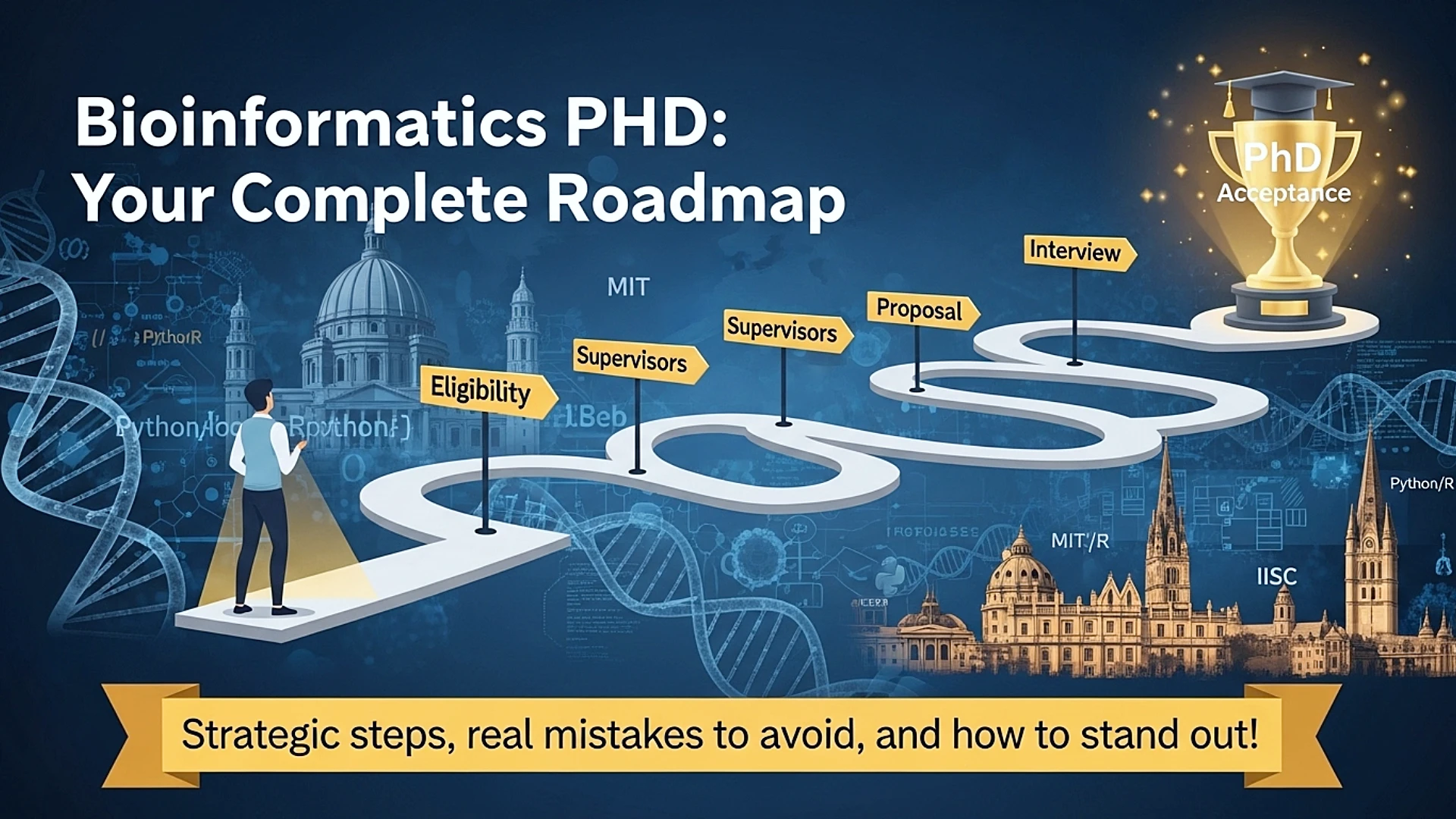
Your complete roadmap to navigating the Bioinformatics PhD application process with confidence
Introduction
Getting into a Bioinformatics PhD is not just about good grades. It's about clarity, strategy, and direction. In an era where artificial intelligence meets biology, computational genomics drives drug discovery, and data-driven approaches revolutionize personalized medicine, the demand for skilled bioinformaticians has never been higher. Yet many talented candidates struggle with the application process - not because they lack qualifications, but because they don't understand the strategic approach required.
If you're planning to apply for a Bioinformatics PhD, here's a complete step-by-step guide that covers everything from eligibility assessment to interview preparation. This roadmap will help you present your best application, connect with the right supervisors, and position yourself for acceptance into competitive programs worldwide.
What a Bioinformatics PhD Actually Involves
A Bioinformatics PhD is fundamentally different from coursework-based master's programs or even data science degrees. While those programs teach you existing knowledge and techniques, a PhD requires you to generate new knowledge through original research. You'll spend 3-5 years (depending on country and program) developing computational methods to solve biological problems - whether that's analyzing genomic sequences, modeling protein structures, building machine learning algorithms for disease prediction, or creating databases for biological information.
Unlike an MSc in Bioinformatics that follows structured coursework, a PhD in Bioinformatics centers on independent research under faculty supervision. You'll identify research questions, design methodologies, analyze complex datasets, and defend your findings. The work combines programming skills (Python, R, Bash), statistical analysis, biological knowledge, and critical thinking. Most programs include some coursework in the first year, followed by comprehensive exams, then full-time research culminating in a dissertation.
This differs fundamentally from computational biology PhD programs, which may emphasize theoretical modeling over practical bioinformatics applications, and from pure computer science programs that lack the biological context. Understanding these distinctions helps you target the right programs for your interests and career goals.
Step 1: Check Your Eligibility and Research Background
Most Bioinformatics PhD programs require a master's degree in relevant fields - Bioinformatics, Biotechnology, Life Sciences, Computer Science, Statistics, or related disciplines. However, the key isn't just your degree title; it's whether you have the foundational knowledge that research demands. Strong candidates typically demonstrate coding experience (even self-taught), a statistics background, and a genuine interest in biological questions.
Academic requirements vary by region. In India, institutions like IISc, IITs, and NIPER typically require a minimum 60-70% in your master's degree or a qualifying score in national entrance exams like GATE, NET, or DBT-JRF. United States programs often expect GRE scores (though many are now test-optional) and prefer GPAs above 3.5/4.0. European programs like EMBL, Oxford, and Max Planck institutes place greater emphasis on research experience and motivation than on standardized test scores.
International applicants should note language requirements: IELTS (typically 6.5-7.0 overall) or TOEFL (90-100 iBT) for non-native English speakers. But here's the critical insight most applicants miss: meeting minimum eligibility doesn't guarantee admission. What actually matters is demonstrating research potential through publications, projects, computational skills, and a clear research direction. Build these foundations before applying - take online courses in programming and statistics, complete independent projects analyzing public datasets, or contribute to open-source bioinformatics tools.
Step 2: Identify the Right Bioinformatics PhD Program
How to Shortlist Universities and Labs
The biggest mistake applicants make is choosing universities based on rankings rather than research fit. A top-ranked university studying plant genomics won't help if you're passionate about cancer bioinformatics. Instead, identify specific research labs whose work excites you. Read recent papers from labs you're considering - do their research questions intrigue you? Do their methodologies align with skills you want to develop?
For applicants targeting India, consider institutions like IISc Bangalore (strong in structural bioinformatics), IIT Delhi and IIT Madras (computational genomics), JNU (evolutionary bioinformatics), NIPER Mohali (pharmaceutical bioinformatics), and IGIB (genomic medicine). Each has distinct research strengths that should guide your choices.
International programs worth exploring include MIT and Stanford for cutting-edge AI applications in biology, Yale and Harvard for genomics and personalized medicine, EMBL for European collaborative research, Oxford for computational systems biology, and Max Planck Institutes for interdisciplinary approaches. Use tools like Google Scholar to find labs publishing in your area of interest, then check if they're accepting PhD students.
The research group matters more than the institution's overall prestige. A productive lab with an engaged mentor at a mid-tier university often provides better training and outcomes than a famous but disengaged supervisor at a prestigious school. Look for labs with recent publications, graduating students, collaborative environments, and funding stability.
Step 3: Contact Potential Supervisors the Right Way
Cold emailing potential PhD supervisors is an art that separates accepted candidates from rejected ones. Most professors receive dozens of generic emails weekly and delete them immediately. Your email must demonstrate genuine interest in their specific work, not just a desire for "a PhD position." Read their recent publications thoroughly. Understand their research questions, methodologies, and current directions. Then craft a personalized message explaining why their work resonates with you.
Your email should be concise - 2-3 short paragraphs maximum. First paragraph: introduce yourself briefly and state your interest in their specific research area. Second paragraph: demonstrate you've read their work by referencing a recent paper and explaining what aspect interests you or what questions it raises for you. Mention how your background prepares you for this research direction. Third paragraph: Request a brief conversation to discuss potential opportunities and attach your CV
Common mistakes to avoid: don't send identical emails to multiple professors in the same department (they compare notes), don't exaggerate your skills or experience (you'll be caught during interviews), don't write lengthy life stories (busy professors won't read them), and don't demand responses or act entitled to positions. Here's a mini example structure:
"Dear Dr. [Name], I am interested in pursuing a Bioinformatics PhD focused on [specific topic], and your recent work on [specific paper/project] particularly resonates with my research interests in [area]. Your approach to [specific methodology] addresses questions I explored during my master's thesis on [brief relevant detail]. With my background in [relevant skills], I am eager to contribute to [specific future direction of their research]. Would you be available for a brief conversation about potential PhD opportunities in your lab? I have attached my CV for your review."
Step 4: Write a Strong Research Proposal and SOP
Many applicants confuse research proposals with statements of purpose, but they serve different functions. Your Statement of Purpose explains your journey - why bioinformatics, why this program, why this supervisor, and how your background has prepared you. It's personal, narrative, and focused on motivation and fit. Write it in a compelling story arc: what sparked your interest, how you've pursued it, what you want to achieve, and why this specific program is the right next step.
Your research proposal, conversely, is a technical document outlining potential PhD research. It should define a clear biological problem, explain why it matters, propose computational approaches to address it, and discuss expected outcomes. Include sections on background/motivation, research objectives, proposed methodology, anticipated challenges, and significance of expected results. Remember - this isn't a contract; it's demonstrating you can think like a researcher.
When crafting your Statement of Purpose, focus on specificity over generic statements. Instead of "I am passionate about bioinformatics," write "Analyzing RNA-seq data during my master's project revealed how computational approaches can uncover hidden biological patterns, particularly when I discovered [specific finding]." Show, don't tell. Mention specific professors, papers, or resources in the program that attract you. Explain how their strengths align with your development needs.
Modern applicants can leverage AI tools like ChatGPT for brainstorming and structural suggestions, but never submit AI-generated content directly. Use these tools to organize thoughts, identify weak arguments, or polish grammar with Grammarly, but ensure every sentence reflects your genuine voice and experiences. Admission committees can spot generic AI writing immediately.
Step 5: Collect and Organize All Application Documents
Successful applications require meticulous organization. Start gathering documents 6-8 months before application deadlines. You'll need a comprehensive CV highlighting education, research experience, technical skills (programming languages, bioinformatics tools, statistical methods), publications or posters, relevant coursework, and any awards or fellowships. Unlike industry resumes, academic CVs should be detailed and comprehensive.
Request Letters of Recommendation (LORs) at least two months before deadlines from professors or research supervisors who know your work deeply. Generic letters from famous names help less than detailed, specific letters from researchers who can discuss your capabilities, work ethic, and research potential. Provide your recommenders with your CV, research statement, and specific programs you're applying to - make their job easier.
Gather official transcripts from all universities attended, degree certificates, and consolidated mark sheets. For international applications, you may need certified translations if original documents aren't in English. Prepare language proficiency test scores (IELTS/TOEFL), ensuring they'll remain valid through your program start date - most are valid for two years. Create a master spreadsheet tracking each program's requirements, deadlines, and submission status to avoid missing critical dates.
Step 6: Get Ready for the Bioinformatics PhD Interview
Bioinformatics PhD interviews typically combine technical assessment, research discussion, and motivation evaluation. Common formats include presenting your previous research (15-20 minutes), answering technical questions about methods and concepts, discussing your future research interests, and explaining why you chose this program and supervisor. Prepare thoroughly for each component rather than hoping to improvise.
Anticipate questions like: What bioinformatics tools and programming languages do you use regularly? Can you explain your master's thesis methodology and findings? Which recent paper in our lab's research area interested you most and why? How would you approach [hypothetical research problem]? Where do you see bioinformatics heading in the next decade? Why this university and supervisor specifically? What are your career goals post-PhD?
Technical questions might probe your understanding of sequence alignment algorithms, statistical methods for differential gene expression, machine learning applications in biology, or database structures. You won't know everything - that's expected. What matters is demonstrating clear thinking, honestly admitting knowledge gaps, and showing how you'd find answers. Prepare by reading recent papers from your potential lab, reviewing fundamental bioinformatics concepts, and practicing explaining your previous research clearly to non-specialists.
Build confidence through mock interviews with professors or peers. Practice presenting your research within time limits until you can explain complex work accessibly. Prepare thoughtful questions to ask interviewers about lab culture, collaboration opportunities, available computational resources, and typical PhD timelines. Your questions demonstrate genuine interest and help you evaluate fit from your side too.
Step 7: Wait for Results and Prepare for Relocation/Funding
After interviews, expect 2-8 weeks for decisions, depending on the program. Use this time productively rather than anxiously checking email constantly. If you're applying internationally, research visa requirements - student visas can take 2-3 months to process. Understand the funding structure of programs you've applied to: many PhD programs offer full funding, including tuition waiver and stipend, but this isn't universal, especially in some Asian countries.
Explore scholarship opportunities, including government fellowships [Prime Minister's Research Fellowship (India), Fulbright for US Programs, DAAD Scholarships (Germany)], university-specific scholarships, and external research grants. Having external funding can strengthen your application because you're less the financial burden on the lab. Research cost-of-living in potential cities - stipends that seem generous may be inadequate in expensive cities like San Francisco or London.
For international relocation, consider housing arrangements, healthcare requirements, cultural adaptation, and community resources. Join online groups for international students at your target universities to gather practical insights. Prepare financially for initial setup costs - first month's rent, deposits, basic furnishings - which can total $2,000-5,000 depending on location.
Mistakes That Reduce Your Bioinformatics PhD Selection Chances
Avoid these common pitfalls that damage applications: Applying without researching supervisor-lab compatibility is the biggest mistake - you'll seem unmotivated and unprepared. Sending generic emails to multiple professors is immediately obvious and suggests you don't genuinely care about their specific work. Weak or copied SOPs that could apply to any program demonstrate a lack of serious thought and commitment.
Poor presentation during interviews - whether rambling explanations, inability to discuss your own research clearly, or failing to ask thoughtful questions - signals you're not ready for independent research. Having no clear research direction beyond "I like bioinformatics" suggests you haven't thought deeply about what you want to study or achieve. Exaggerating skills on your CV that you can't demonstrate when questioned destroys credibility immediately.
Missing deadlines or submitting incomplete applications wastes opportunities. Ignoring fit in favor of prestige leads to miserable PhD experiences, even if you get accepted. Finally, giving up after rejections instead of learning from them and improving future applications prevents eventual success. Most successful PhD students faced multiple rejections before finding the right fit.
Conclusion
Successfully applying for a Bioinformatics PhD requires strategic preparation across multiple dimensions: building strong technical foundations, identifying research areas and supervisors that genuinely excite you, crafting compelling application materials that showcase your potential, and preparing thoroughly for interviews. The process demands clarity about your research interests, honesty about your current capabilities, and strategic thinking about program fit.
Start by shortlisting programs based on research alignment rather than rankings alone. Contact potential supervisors thoughtfully with personalized emails demonstrating genuine interest in their work. Develop your proposal and SOP to tell a coherent story of your journey and aspirations. Prepare meticulously for interviews by understanding both technical concepts and your potential lab's research deeply.
The application process is competitive but not insurmountable. Every successful PhD student started exactly where you are now - uncertain, preparing applications, hoping for acceptance. What distinguishes accepted candidates isn't perfection; it's preparation, genuine passion for research, and clear communication of how they'll contribute to their field. Begin today by choosing 3-5 programs that align with your interests and reaching out to potential supervisors. Your Bioinformatics PhD journey starts with this first step.
Frequently Asked Questions
Founder of BTGenZ. Passionate about simplifying biotechnology for the next generation and bridging the information gap for aspiring biotechnologists in India.

Related Reads
Engage with Our Community
Join the conversation and share your thoughts with the BTGenZ community!
Connect on LinkedInLoading commenting section...
Comments Section
No approved comments yet. Be the first to leave a comment!